
ASAT builds the ACE range of powered rope ascenders — three machines that climb a fixed Ø11 mm rope under motor power, separated by how much they lift and how much they weigh to carry there.
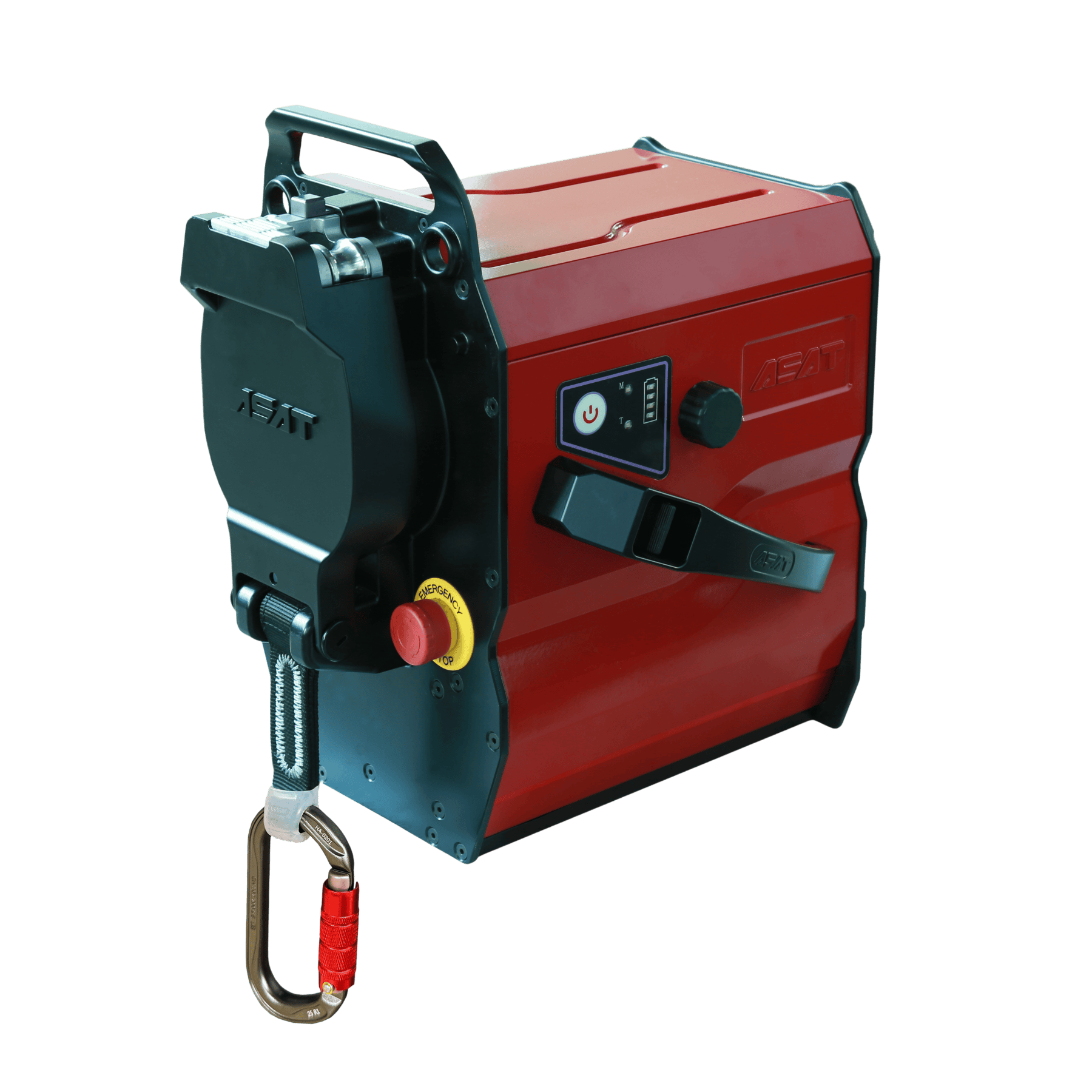 ASAT
ASAT
18 kg · 260 kg WLL · IP56 · 150 m remote · Highest working load we stock
$11,100 USD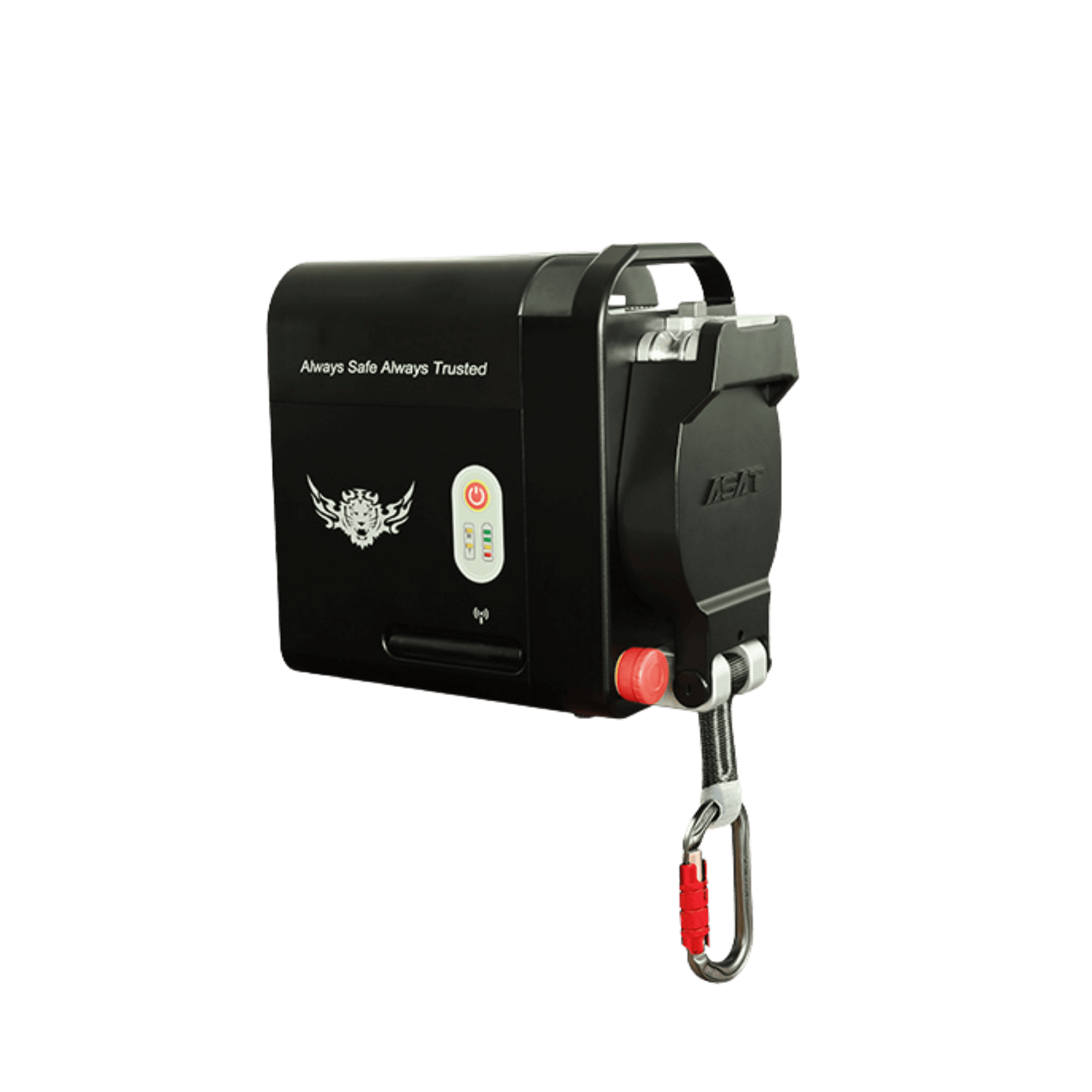 ASAT
ASAT
10.5 kg · 180 kg WLL · IP54 · 150 m remote · Vertical, horizontal & inclined
$7,800 USD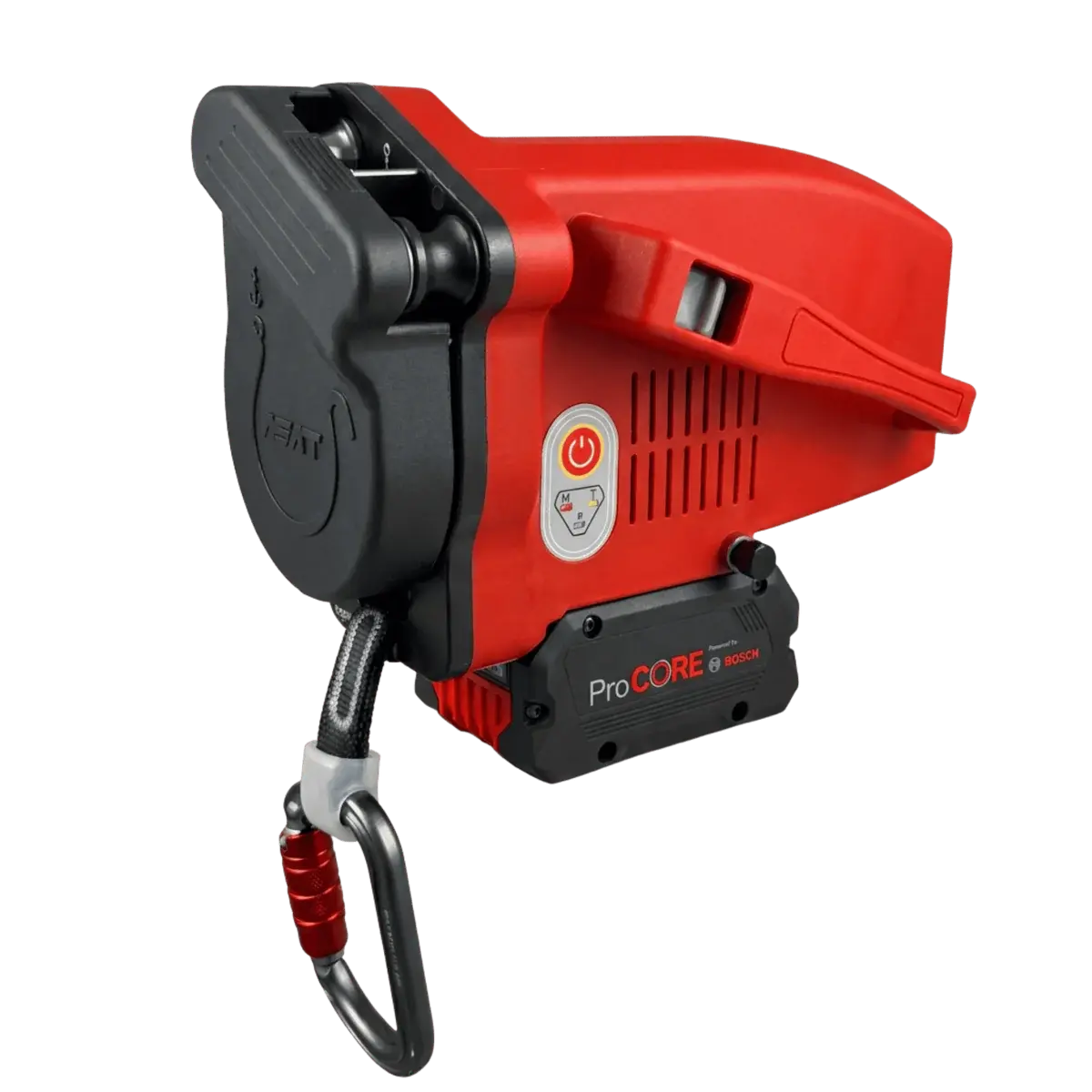 ASAT
ASAT
3.5 kg · 150 kg WLL · Bosch ProCORE battery · 100 m remote · Carried in one hand
$2,500 USDThe ACE range is not a good, better, best ladder. The three models answer the same question with different trade-offs, and the trade-off is weight against capacity: the ACE-51 is 3.5 kg without its battery and lifts 150 kg, the ACE-22 is 10.5 kg and lifts 180 kg, the ACE-24 is 18 kg with its battery and lifts 260 kg. Those are working load limits; the rated loads behind them are 100, 140 and 180 kg.
That means the lightest unit is not the entry-level one. Someone carrying a machine up a tower and across a walkway is buying the ACE-51 for the 3.5 kg, not settling for it, and someone raising two people and a toolbag from a tripod is buying the ACE-24 for the 260 kg and accepting that it takes two hands to move. Direction is the other axis, and it does not follow capacity: the ACE-22 and the ACE-24 are both specified for vertical, horizontal and inclined travel, while the ACE-51 is specified for ascent and descent on a fixed line, or hauling and lowering from an anchor.
| ACE-51 | ACE-22 | ACE-24 | |
|---|---|---|---|
| Working load limit | 150 kg | 180 kg | 260 kg |
| Rated load | 100 kg | 140 kg | 180 kg |
| Weight | 3.5 kg, without battery | 10.5 kg | 18 kg, incl. battery |
| Ascent speed | 0–15 m/min | 0–30 m/min | 0–30 m/min |
| Descent speed | 0–20 m/min powered | 0–40 m/min | 0–40 m/min |
| Battery | Bosch ProCORE 18V, removable, sold separately | Swappable Li-ion | Swappable Li-ion |
| Charge time | < 2 h (8 Ah) | < 60 min | < 60 min |
| Range, alternating | > 400 m @ 100 kg | ≈400 m @ 120 kg | ≈700 m @ 150 kg |
| Ingress protection | — | IP54 | IP56 |
| Remote control | Wireless, > 100 m | 0–150 m | 0–150 m |
| Dimensions | 25 × 13 × 17 cm | 27 × 16 × 24 cm | 31 × 23 × 35 cm |
| Operation | Ascent and descent on a fixed line, or hauling from an anchor | Vertical, horizontal and inclined traverse | Vertical, horizontal and inclined traverse |
| Rope | Ø11 mm, EN 1891 A | Ø11 mm, EN 1891 A | Ø11 mm, EN 1891 A |
| Recommended ropes | 8 named | 7 named | 5 named |
All three run on Ø11 mm semi-static rope to EN 1891 A, and all three are stepless: speed comes off a control lever rather than a set of preset gears, so the operator meters the climb rather than choosing a speed before starting. All three descend under power as well as ascend, and all three keep a manual descent path that works with the power off.
All three are CE marked under the Machinery Directive 2006/42/EC and covered by the same EC type-examination — certificate 3400220822, issued by Safenet Certification Services, Notified Body 2805 — applied against EN 60204-1, EN ISO 12100 and EN ISO 13849-1. They are work and access devices, not fall arresters: each is used on the working rope with an independent backup device on a separate safety line.
Speed is the first divergence. The ACE-51 ascends at 0-15 m/min and descends at up to 20 m/min under power; the ACE-22 and ACE-24 both ascend at 0-30 m/min and descend at up to 40 m/min. On a tall structure that difference compounds over a shift.
Battery is the second, and it is the one that changes how the unit is owned. The ACE-51 takes a removable Bosch ProCORE 18V pack — 8 Ah or 12 Ah, sold separately — so a crew already on Bosch Professional tools charges it with what is in the van. The ACE-22 and ACE-24 carry their own swappable lithium-ion packs, charging in under an hour.
Range follows capacity and battery. The ACE-51 covers more than 400 m of alternating travel at 100 kg on the 8 Ah pack, the ACE-22 about 400 m at 120 kg, and the ACE-24 about 700 m at 150 kg. Ingress protection is recorded as IP54 on the ACE-22 and IP56 on the ACE-24. The remote is wireless on all three: beyond 100 m in the open on the ACE-51, and 0-150 m on the other two.
Start with the load, because it is the only figure that cannot be worked around: 150, 180 or 260 kg as a working load limit. If the answer is comfortably inside the ACE-51, the next question is whether anyone has to carry the machine, and how far — that is the whole argument for the lightest model. Where the load is heavier than its 150 kg limit, the record specifies that the ACE-51 can be rigged through a pulley system — up to 250 kg on a 2:1 or 400 kg on a 3:1 — by competent personnel.
If the work runs horizontally or on an incline rather than straight up, the ACE-22 and the ACE-24 are the two models specified for it; the ACE-51 is not. If the job is raising more than one person, or a person plus equipment, from a tripod or a davit arm, the ACE-24 is the one with the capacity for it. Where the answer is not obvious from those three questions, tell us the height, the load and where the unit will live between jobs.
Decide on working load limit first: the ACE-51 is rated to 150 kg, the ACE-22 to 180 kg and the ACE-24 to 260 kg. If the load fits the ACE-51, its 3.5 kg without battery makes it the one to carry. The ACE-22 and the ACE-24 are both specified for vertical, horizontal and inclined travel; the ACE-51 is not. The ACE-24 is the highest capacity in the range.
All three are CE marked under the Machinery Directive 2006/42/EC and covered by EC type-examination certificate 3400220822, issued by Safenet Certification Services, Notified Body 2805. The applied standards recorded against the range are EN 60204-1, EN ISO 12100 and EN ISO 13849-1. Read the declaration of conformity for the specific model for the duty it is certified for.
Ø11 mm semi-static kernmantle rope to EN 1891 A, across all three models. The anchor is to EN 795 or ANSI/ASSE Z359.15, the harness full body to EN 361 and EN 813, and connectors to EN 362.
The ACE-51, at 3.5 kg without its battery, measuring 25 × 13 × 17 cm. It is the only model in the range that runs on a removable Bosch ProCORE 18V pack rather than a dedicated battery, which is also what keeps that figure down — the battery is not counted because it does not live in the unit.
The ACE-51's record specifies up to 250 kg on a 2:1 and 400 kg on a 3:1, rigged by competent personnel. That is a rigging configuration, and it does not change the 150 kg working load limit the unit itself is rated to on a single line.