
Confined space and rescue tripods with winches, for manhole, tank, vault and silo entry. Portable anchor and retrieval systems that set up over the opening.
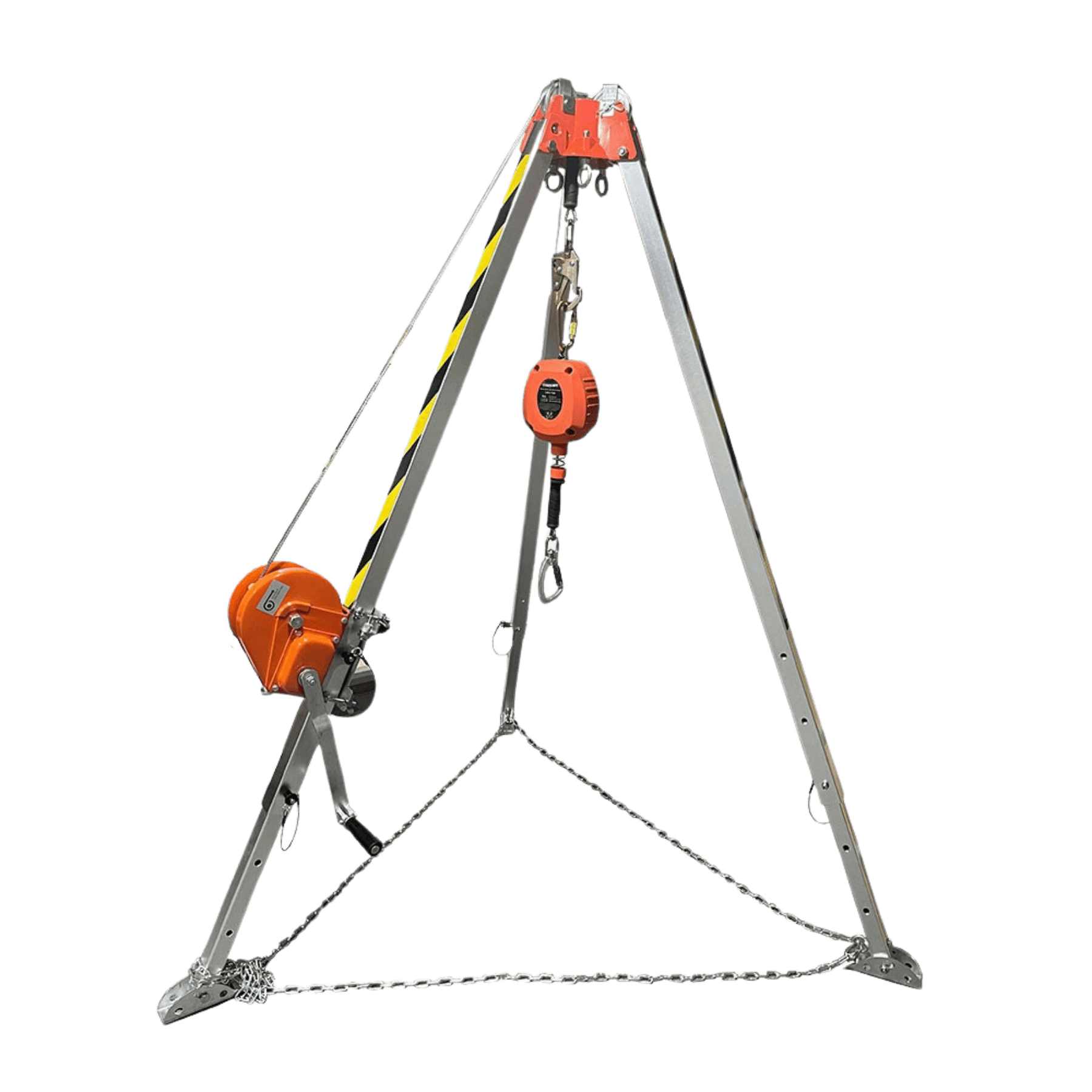
Confined space and rescue tripods supplied as complete systems with the winch fitted, rather than as a frame you then have to match a device to. That pairing is where most of the specification errors in this category happen, and buying it as one item removes them.
Before ordering, the two measurements worth sending us are the opening — width and any raised rim the legs have to clear — and the depth. Those decide leg span and whether the retrieval length is enough. If you are entering the same openings regularly, it is also worth telling us, because that changes whether a portable or a fixed installation makes more sense.
Confined space entry has a geometry problem: the opening is in the floor, and there is nothing above it to anchor to. A tripod stands over the opening and puts an anchor point directly above the entrant, so they can be lowered in, held on fall protection while working, and — critically — raised out without anyone else entering.
That last part is what the equipment is bought for. Rescue from outside the space — non-entry rescue — is the approach regulators and rescue teams build around, and NIOSH data on confined space incidents is the reason why. A tripod with a retrieval winch is what makes it possible: the attendant can bring the entrant out from where they are standing.
A working setup is a tripod, a retrieval device and usually a separate fall arrest device — often a self-retracting lifeline with an integral rescue function, mounted on a tripod leg. The winch raises and lowers; the fall arrest device catches a fall. Asking one device to do both is a specification error worth avoiding.
Leg locks, chain or strap restraints between the feet, and non-slip feet are what keep the geometry stable under load. A tripod's rating assumes its legs are where they were designed to be, and the restraint that holds them there is not optional hardware.
EN 795 covers anchor devices and sorts them by type: Type A needs fixing to the structure, Type B does not, which is where a tripod sits. EN 1496 covers rescue lifting devices and splits them into Class A, lifting only, and Class B, which also allows limited lowering — a distinction that decides whether you can bring an entrant back down as well as up. EN 1497 covers rescue harnesses. In North America, ANSI/ASSP Z359.4 covers assisted-rescue and self-rescue systems.
In the United States the requirement itself comes from OSHA, not from a standard. 1910.146 governs permit-required confined spaces in general industry and 1926 Subpart AA covers construction. A retrieval system — retrieval line, harness, and a lifting device or anchor — is required for non-entry rescue, with the line attached to a mechanical device or fixed point outside the space so retrieval can start the moment it is needed. For vertical spaces deeper than 5 ft, a mechanical device must be available. That is the regulation this equipment exists to satisfy.
Lifting a person is a different duty from lifting a load, and a winch rated for materials is not automatically rated for personnel. Which standards a specific tripod, winch or lifeline carries is stated in its declaration of conformity — check each component, because a system does not inherit the highest rating within it.
Leg span and height set what openings the tripod can straddle and how much headroom the entrant has. A wide manhole with a raised rim needs a different footprint from a flush floor hatch in a plant room.
Weight and packed size decide whether one person can carry and rig it, which matters when the same crew moves between several openings in a shift. Aluminium is the usual answer for portability, steel where the tripod stays put.
Then check what the tripod is designed to carry: mounting brackets differ between manufacturers, and a winch or lifeline that does not mount to the legs you own is an expensive lesson.
They are the same equipment, described from two directions. "Confined space tripod" names the application — entry into manholes, tanks and vaults — while "rescue tripod" names the retrieval function. Products are commonly listed under both terms.
In most configurations, yes. The retrieval winch raises and lowers under control; a fall arrest device catches a fall. Some systems combine them in a single unit with an integral rescue function, but where they are separate, both are required. The product documentation states what each device is rated to do.
Only if that specific winch is rated for it. Lifting people and lifting loads are different duties under different standards, and a device approved for one is not automatically approved for the other. Check the rating for the individual winch rather than assuming from the tripod.
Leg span has to straddle the opening and clear any raised rim, and height sets the headroom above the entrant. Beyond that, weight and packed size decide whether the crew can rig it where it is needed, and the mounting brackets have to match the winch or lifeline you intend to fit.
 Top Lift