
KMA builds one powered rope ascender in four sealed builds — industrial, fire and rescue, tactical and military — rated from 110 to 200 kg and separated by how much water and dust each is built to survive.
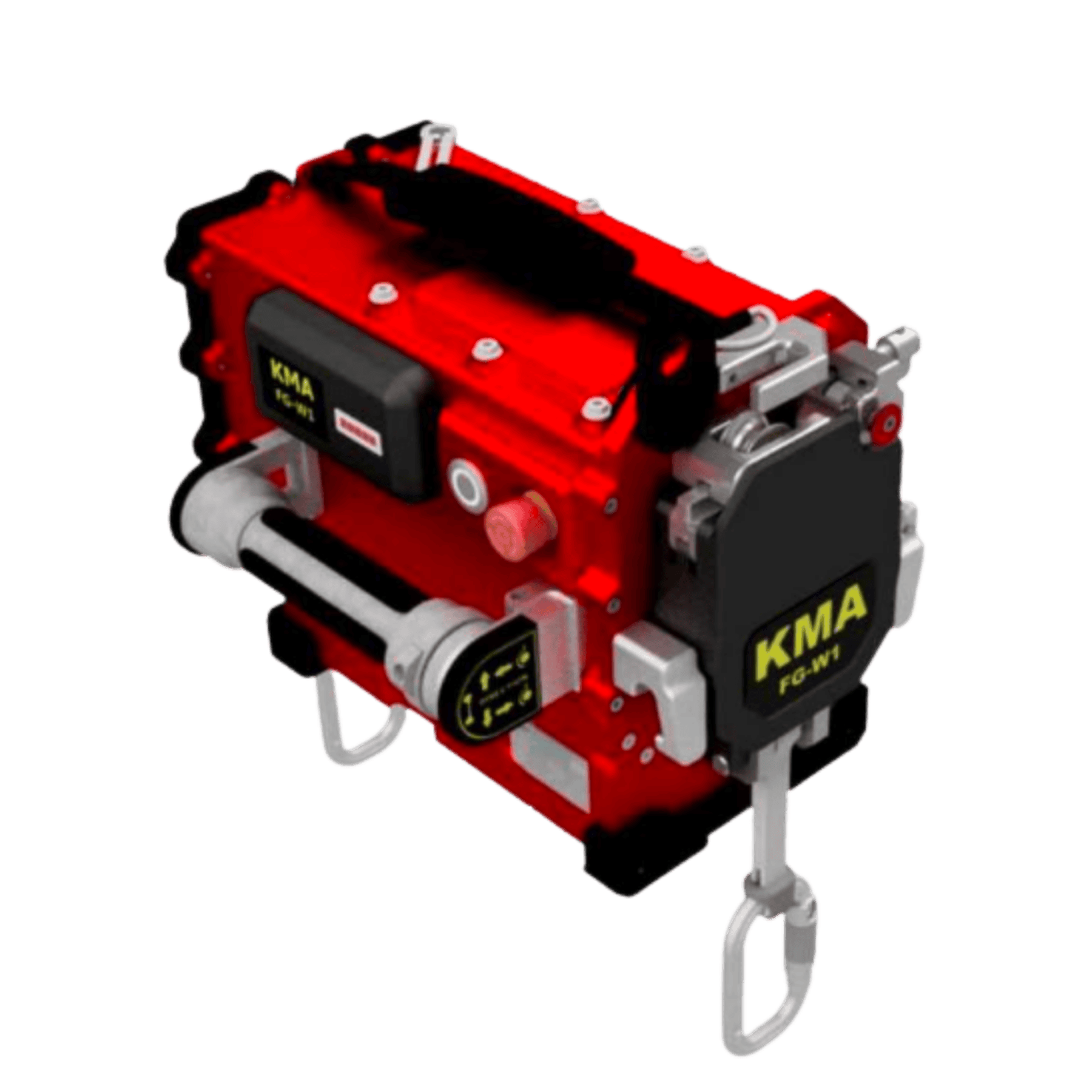 KMA
KMA
≈15 kg · 110–200 kg WLL · IP66 · 100 m remote · Firefighting
$22,150 USD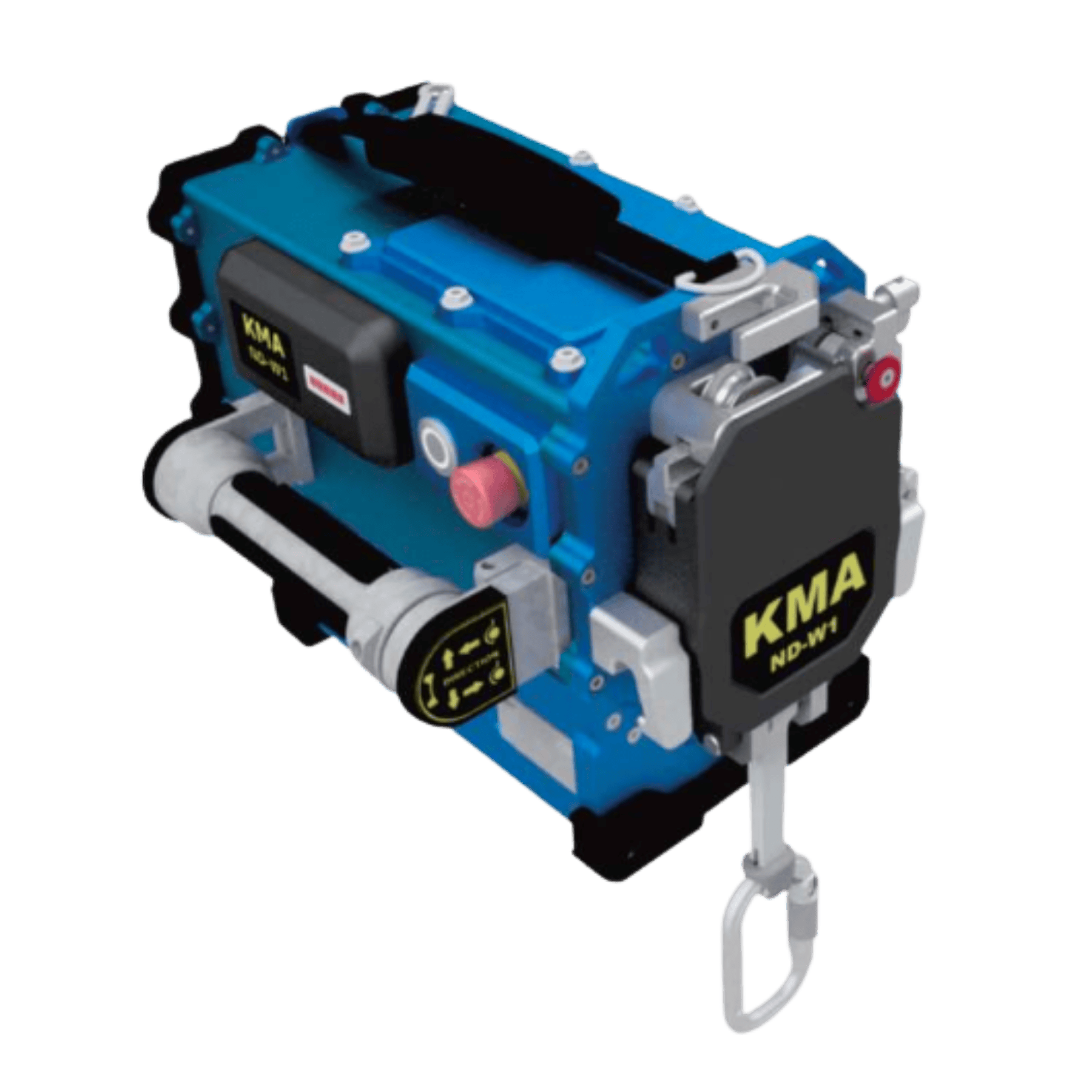 KMA
KMA
≈15 kg · 110–200 kg WLL · IP65 · 100 m remote · Industrial
$20,390 USD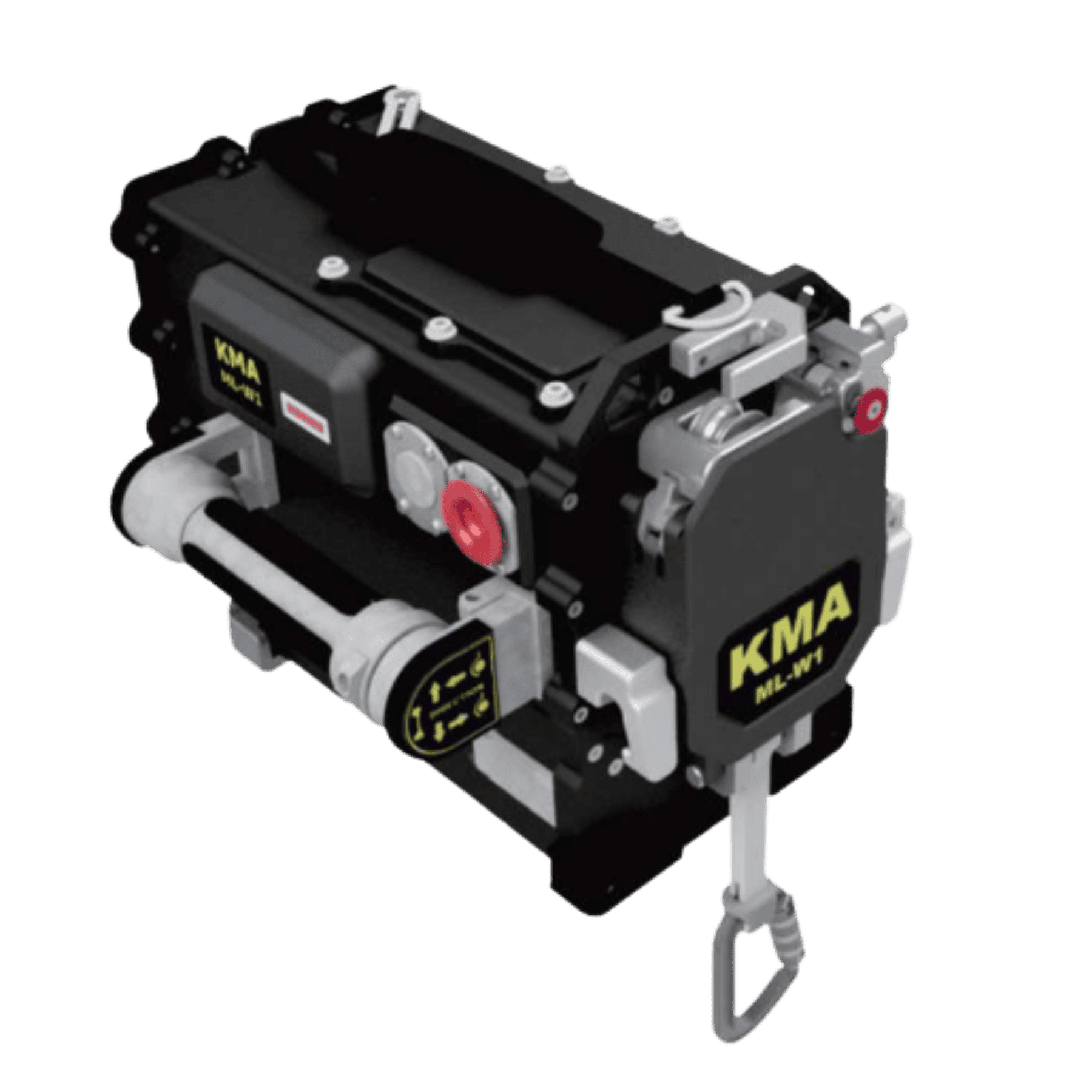 KMA
KMA
≈15 kg · 110–200 kg WLL · IP68 · 100 m remote · Tactical & military
Request a Quote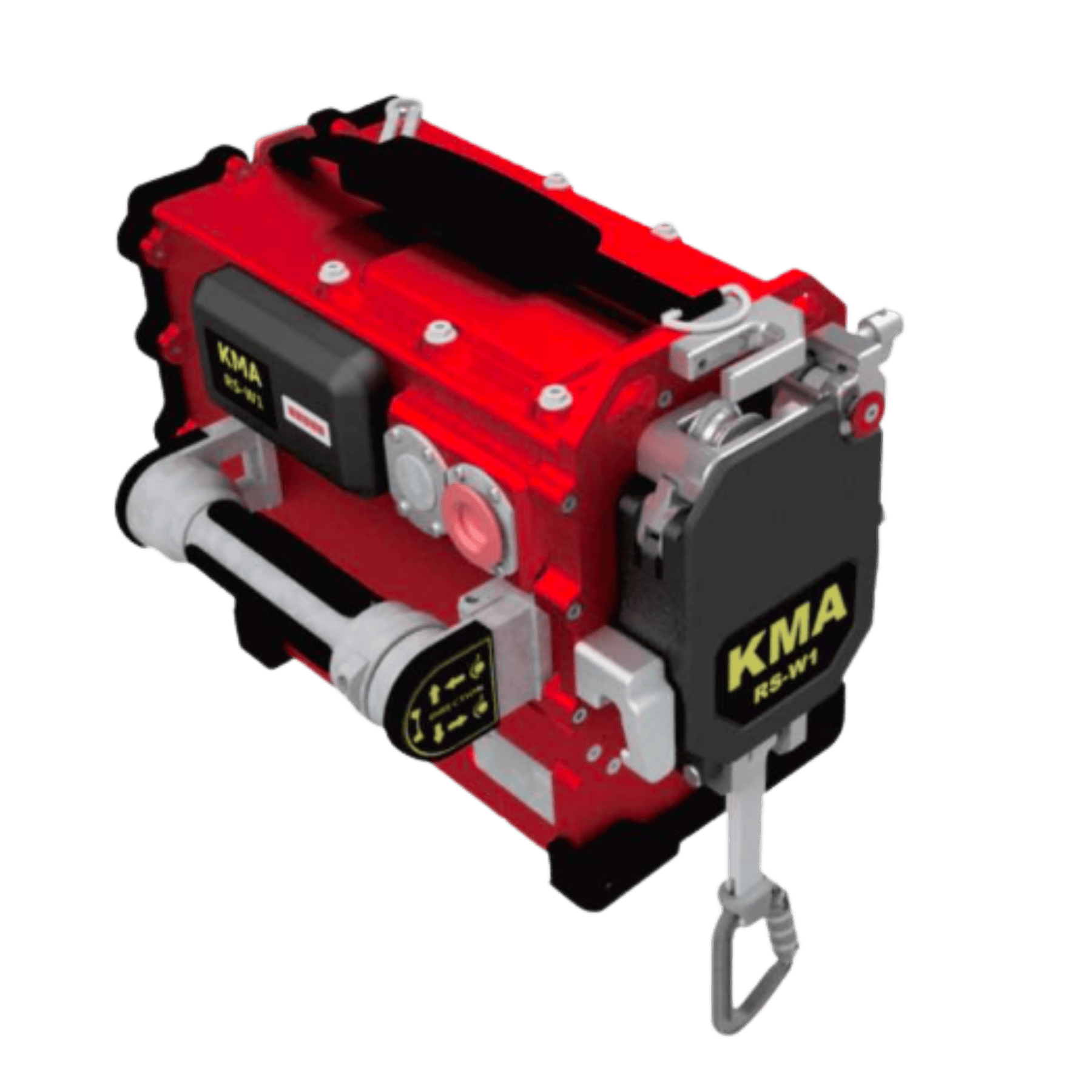 KMA
KMA
≈15 kg · 110–200 kg WLL · IP67 · 100 m remote · Rescue
Request a QuoteThe KMA range is the clearest case in this catalogue of a single machine packaged for four different jobs. All four share a rated load of 110-200 kg depending on configuration, a maximum load of 120-250 kg, ascent to 0.9 m/s, an attachable 36 V 10 Ah lithium battery good for roughly 600 m of ascent at 100 kg, and an aluminium alloy body of about 14.5-15.5 kg.
What changes between them is sealing, colour and the sector each is specified for: the KMA-ND at IP65 in blue for industrial work, the KMA-FG at IP66 in red for fire and rescue, the KMA-RS at IP67 in black or red for tactical use, and the KMA-ML at IP68 in khaki or black for defence. That is the decision, and it is not a small one — an ingress rating is built into the housing and cannot be added later.
| KMA-ND | KMA-FG | KMA-RS | KMA-ML | |
|---|---|---|---|---|
| Built for | Industrial | Fire & rescue | Tactical | Military |
| Ingress protection | IP65 | IP66 | IP67 | IP68, 10 m / 5 h |
| Colour | Blue | Red | Black / Red | Khaki / Black |
| Rated load (WLL) | 110–200 kg | 110–200 kg | 110–200 kg, incl. 170 kg option | 110–200 kg, incl. 170 kg option |
| Max load | 120–250 kg | 120–250 kg | 120–250 kg | 120–250 kg |
| Ascent speed | up to 0.9 m/s | up to 0.9 m/s | 0.45–0.9 m/s | 0.45–0.9 m/s |
| Range per charge | ≈600 m @ 100 kg | ≈600 m @ 100 kg | ≈600 m @ 100 kg | ≈600 m @ 100 kg |
| Battery | 36 V / 10 Ah | 36 V / 10 Ah | 36 V / 10 Ah | 36 V / 10 Ah |
| Weight | ≈14.5–15.5 kg | ≈14.5–15.5 kg | ≈14.5–15.5 kg | ≈14.5–15.5 kg |
| Operating temperature | −20 to +40 °C | −20 to +40 °C | −20 to +40 °C | −20 to +40 °C |
| Remote control | 100 m, optional | 100 m, optional | 100 m, optional | 100 m, optional |
| How it is bought | Priced online | Priced online | Quoted | Quoted |
IP65 is dust-tight and protected against water jets. IP66 raises that to powerful water jets, which is the difference between a machine that gets rained on and one that gets hosed. IP67 adds survival of temporary immersion. The KMA-ML's IP68 is specified in its record as underwater to 10 m for 5 hours, which is a different order of claim from the other three.
The reason this is the axis the range is built on is that none of the other numbers move. If you are choosing a KMA, you are not choosing capacity or speed — you are choosing how much of the environment the housing has to keep out, and buying the one whose rating matches the worst day the machine will have.
All four carry the same safety set, as their records state it: an electromagnetic brake (electronic) plus a mechanical emergency brake, a mushroom-type emergency stop, and a manual descent lever alongside the powered throttle. Two independent brakes rather than one is the part worth noticing on a machine that holds a person; how each is meant to be used is set out in the manufacturer's manual, not here.
The remote is a 100 m unit, listed as optional and password-protected. Two of the four models — the KMA-RS and the KMA-ML — carry a mid-range option in their records, a 170 kg rated load and a 0.65 m/s speed step between the extremes of the band.
All four are CE marked under the Machinery Directive 2006/42/EC and covered by an EC type-examination from ECM, Notified Body 1282, certificate ECM MD-B 2022-0T64. The applied standards recorded are EN ISO 12100, EN 60204-1 and EN 14492-1.
Each is recorded as a powered rope ascender — a work and access device, not a fall arrester. It is used on the working rope, with an independent backup device on a separate safety line. Read the declaration of conformity for the specific model for the duty it is certified for.
The KMA-ND and KMA-FG carry a published price on their product pages. The KMA-RS and KMA-ML are quoted, because the configuration is the specification: the rated load band, the speed option, the rope length, the mounting and the colour are decided against the vehicle or the structure the unit will live on, and there is no single article to price.
Tell us the load, the height, the environment the machine will work in and how it travels between jobs, and we will spec the build and quote it.
Sealing and the sector each is packaged for. All four share the same 110-200 kg rated load band, the same 0.9 m/s top speed, the same 36 V 10 Ah battery and the same braking. The KMA-ND is IP65 for industrial work, the KMA-FG IP66 for fire and rescue, the KMA-RS IP67 for tactical use, and the KMA-ML IP68 for defence. Choose on the environment, because the capacity does not change between them.
Its record specifies IP68, underwater to 10 m for 5 hours — the only unit in this catalogue with an immersion figure of that kind. The other three KMA builds are IP65, IP66 and IP67, which cover water jets and, for the IP67, temporary immersion.
About 600 m of ascent at 100 kg, from an attachable 36 V 10 Ah pack of roughly 360 Wh, across all four builds. Charge time is about 90 minutes and the pack is rated for approximately 500 cycles.
All four are CE marked under the Machinery Directive 2006/42/EC and covered by an EC type-examination from ECM, Notified Body 1282, certificate ECM MD-B 2022-0T64, applied against EN ISO 12100, EN 60204-1 and EN 14492-1. Each is recorded as a work and access device rather than a fall arrester, so it is used on the working rope with independent backup on a separate line.
The remote is listed as optional across the range: a 100 m, password-protected unit. All four also carry a throttle lever on the machine itself, a manual descent lever, a mushroom-type emergency stop and both an electromagnetic and a mechanical brake.